






Joining a 300-Year Story
Handel’s Messiah Returns to the Tennessee Theatre
Nov. 24, 2025 – When the Knoxville Symphony Orchestra and Knoxville Choral Society take the stage this Sunday at the Tennessee Theatre, they’re doing more than performing a beloved holiday tradition. They’re stepping into a story that has connected performers and audiences across three centuries.
“Performing Messiah means entering a story about faith and renewal,” says Music Director Aram Demirjian. “Few works in the classical repertoire invite us so warmly into something larger than ourselves.”
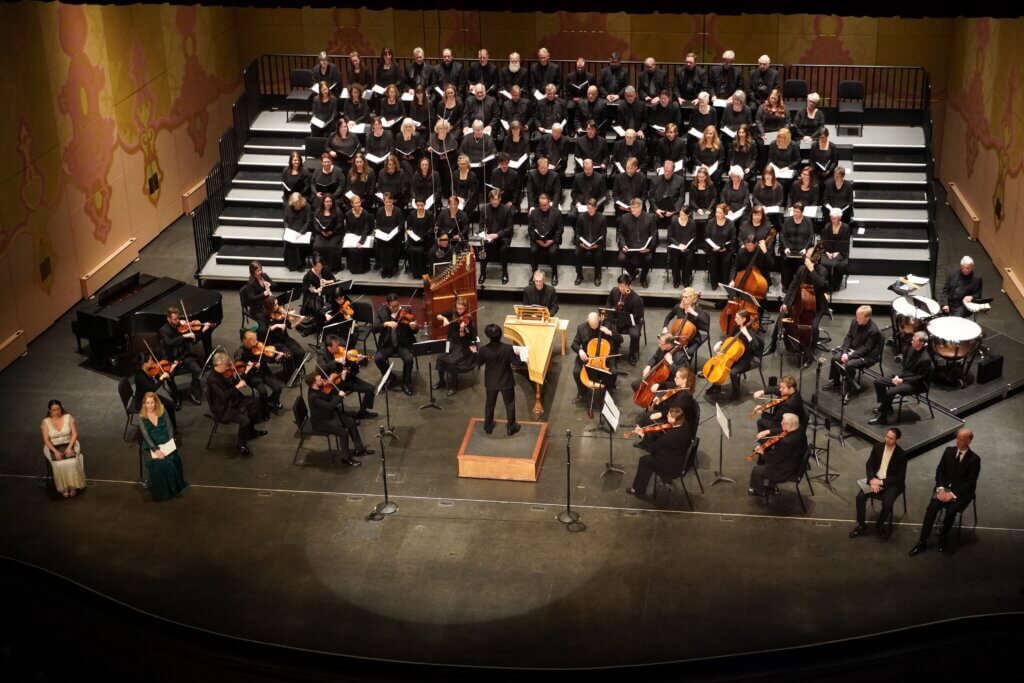
Each performance of Messiah joins Knoxville’s musicians and audiences to a story shared across three centuries.
The piece also deepens and shifts as one’s life changes. For Demirjian, who has conducted Messiah more than any other work in his repertoire, each return to the score reveals something new. “Every time I come back to it, I gain a heightened degree of understanding,” he says. “Not only of the spirit of the music, but how the piece functions and how I can be a better conductor for everyone on stage.”
Bass soloist Kevin Burdette, Knoxville native and University of Tennessee alumnus, describes a similar evolution. Having sung Messiah around the world for more than 25 years, he recognizes how experience has shaped his interpretation. “As I’ve grown with the piece, I’ve leaned more into the moments of stillness,” he says. “It’s become less about showing off my voice and more about telling a story.”
And though his career has taken him to some of the world’s top opera houses – The Metropolitan Opera, La Scala, Santa Fe Opera, Chicago Symphony Orchestra, and many others – performing Messiah with the KSO carries special meaning. “To be able to come and do it in my hometown with Maestro and his band, it is transcendent to me,” Burdette says.
Rebuilding a Knoxville Tradition
When Demirjian joined the KSO in 2016, he was surprised to learn that the orchestra had not performed Messiah in more than 35 years. Bringing it back became a priority, not as a one-off event, but as a tradition to rebuild with intention.
The first performance in 2019 paired Part I with a program of holiday music. After the pandemic pause, the model was repeated. Now, after several successful seasons, Demirjian has begun expanding the performance. “This year’s Messiah is the most fully realized version Knoxville has heard since the tradition’s revival,” he says. “My goal was always to do Messiah as I believe it should be done.”
The KSO’s partnership with the Knoxville Choral Society, led by Artistic Director Dr. John R. Orr, is central to that experience. With volunteer singers from across East Tennessee, the KCS brings to life the oratorio’s great choruses (from the hushed prayer of “And the glory of the Lord” to the jubilant swell of “Hallelujah”), key moments that remain among the most stirring in the entire work. This year’s performance also features a distinguished slate of soloists joining Burdette: Abigail Santos Villalobos, soprano; Jan Wilson, mezzo-soprano; and Eric Ferring, tenor.
Handel wrote Messiah in just 24 days during a period of personal and financial struggle, and its Dublin premiere was a charitable event. Its most iconic tradition, standing during the “Hallelujah” Chorus, began when King George II reportedly rose to his feet, moved by the music. But the reasons Messiah continues to resonate go far beyond history.
Each performance, Demirjian reminds us, is part of something much larger: a shared story that stretches back 300 years and continues forward through every singer, every instrumentalist, and every member of the audience.
Handel’s Messiah – Sunday, Nov. 30 at 2:30 pm at the Tennessee Theatre, part of the Roy Cockrum Chamber Series and sponsored by Sheena McCall Merrill and the UT Federal Credit Union.
Background on Messiah is adapted from the KSO program notes by Ken Meltzer.