






KSO Brings More of Handel’s Messiah to the Stage
For many audiences, Handel’s Messiah reaches its triumphant conclusion with the famous “Hallelujah” Chorus. But as KSO Music Director Aram Demirjian is eager to point out, Handel had much more to say.
On Sunday, November 22, the KSO and Knoxville Choral Society will present a more complete version of Messiah, the culmination of a vision Demirjian has been developing since the orchestra began presenting the work as a holiday tradition in 2019.
“Messiah is my favorite piece to conduct,” said Demirjian, who has led the work more often than any other in his repertoire. “The journey we had in mind was to slowly build the audience’s Messiah experience. Each year, we’ve added a little more.”
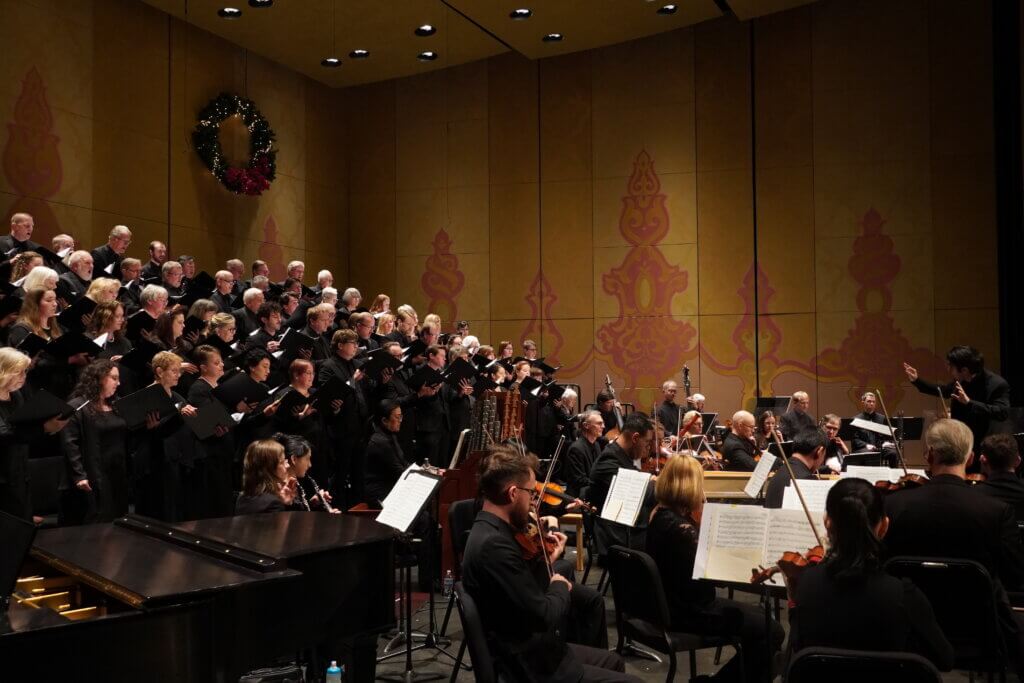
The KSO and Knoxville Choral Society perform Handel’s Messiah at the Tennessee Theatre.
The KSO’s first presentation featured Part One, which includes the familiar Nativity story, and the “Hallelujah” Chorus. Over successive performances, Demirjian has expanded the program to explore more of Handel’s three-part oratorio. This year, audiences will hear all of Part One and much of Parts Two and Three.
“The biggest difference people are going to notice is that the ‘Hallelujah’ Chorus is not the end,” Demirjian explained. “That’s how Handel wrote it. The ‘Hallelujah’ Chorus is the end of Part Two.”
Part Three explores the promise of resurrection and eternal life. Demirjian is particularly enthusiastic about the concluding “Worthy is the Lamb” and “Amen,” which bring the oratorio to an even more magnificent close.
Joining the orchestra are four acclaimed vocal soloists: soprano Song Hee Lee, alto Emily Marvosh, tenor Brian Giebler, and bass Kevin Burdette.
A University of Tennessee graduate who has performed with leading opera companies and orchestras around the world, Burdette has deep Knoxville connections. He believes the power of Messiah extends beyond the music to the shared human experience of storytelling. “That is why we tell stories. That’s also why we go to hear stories, because perhaps I will see myself in your performance,” Burdette said. “And if I see my story in your story, I feel seen.”
Demirjian sees that connection in the story Messiah tells. When librettist Charles Jennens assembled passages from the Old and New Testaments in 1741, he created a narrative that moves from darkness toward hope.
“Whether you practice a faith or don’t practice a faith at all, somehow, in the music, you can feel that emotional journey,” Demirjian said. The message, he suggests, is present from the opening words of the tenor’s first solo, “Comfort ye, my people.”
“That is the entire message of the piece,” he said. “He starts out by saying, ‘It’s going to be okay.'”
Classical Christmas: Handel’s Messiah
November 22, at 2:30 p.m. at the Tennessee Theatre
The concert is part of the Roy Cockrum Chamber Series and sponsored by Sheena McCall.
CLICK FOR MORE: Hear Aram Demirjian explore Handel’s Messiah in a December 2025 episode of the Sticky Notes classical music podcast.