








A New Era for KSO’s Chimes
For more than three decades, the Knoxville Symphony Orchestra’s chimes have been part of its musical voice: marking triumphant moments, adding sparkle to holiday favorites, and ringing out like church bells in Tchaikovsky’s 1812 Overture. But after 30-plus years of service (and hundreds of miles on the road), our trusty chimes had reached the end of their journey.
“They’d been on the truck so much, the wires were cutting into the tubes,” recalls KSO Co-Principal Percussion and Principal Timpani Bob Adamcik. “The frame was being held together by a ratchet strap. Fellow percussionist Jay Oberfeitinger and I knew we needed something that not only sounded better but was more secure.”
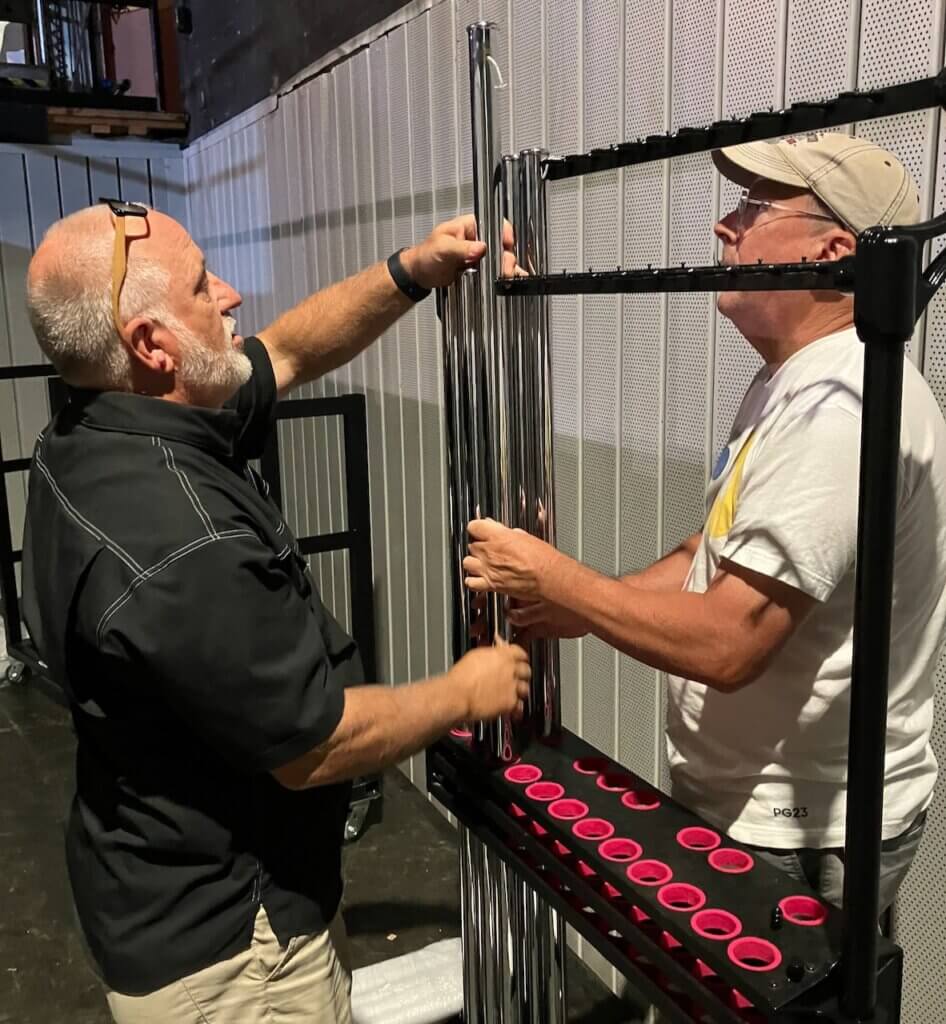
Percussionists Andy Adzima and Clark Harrell carefully assemble KSO’s new Deagan chimes.
For a time, the search for new chimes took a backseat to other percussion needs. The KSO acquired a new equipment case, had bells re-plated by Chicago-based Century Mallet, and ensured other instruments were in top shape. But the chimes stayed on Bob’s mind. And in his ears, a very specific sound was calling: the warm, resonant tone of vintage Deagan chimes, no longer in production.
Opportunities were scarce. When a rare set appeared on eBay for $1,000, it sold within six hours. “We would have bought those in a heartbeat,” Bob says. The breakthrough came thanks to Assistant Principal Percussionist Andy Adzima, who spotted a Facebook post from a chimes specialist (yes, there is such a thing) in Salt Lake City offering a fully refurbished set of 80- to 90-year-old Deagan chimes. The chrome tubes gleamed, the frame was rebuilt, new casters made them easy to roll into place, and the price fit within the KSO’s budget.
When the chimes arrived at the Tennessee Theatre, Bob, Andy and Percussion Co-Principal Clark Harrell got to work although Bob good-naturedly admits he relied on them because they are “much handier” than he is. The team assembled the frame ends, ran the crossbar between them, connected the damper mechanism, and hung each tube, lined with rich red felt that Bob notes, “goes perfectly with the Tennessee Theatre.” One surprise? The frame isn’t bolted together in most places. “Once you put 200 pounds of metal on it, that’s enough to keep it in place,” Bob laughs.
The Sound of the Bells
Orchestral chimes (also called tubular bells) were first developed in the late 19th century to mimic the rich, resonant tone of church bells without their immense size and weight. Each tube is precisely cut to pitch, suspended in a frame, and struck with a rawhide or plastic-headed hammer. A foot pedal operates a felt damper, allowing notes to ring freely or stop cleanly, depending on the music.
While their appearances in the symphonic repertoire are occasional, they’re often unforgettable. The tolling chimes in the finale of Tchaikovsky’s 1812 Overture evoke church bells pealing over a victorious celebration. In Mahler’s Symphony No. 2, they add a solemn, almost otherworldly color. And every December, audiences hear them marking midnight in The Nutcracker—a cue for the mice to arrive and the magic to begin.
The KSO’s new chimes are expected to make their official debut in our performance of Handel’s Messiah this December. Later in the season, audiences can also look forward to hearing them in Leonard Bernstein’s West Side Story and in The Nutcracker ballet, a beloved Christmas tradition presented in collaboration with the Appalachian Ballet Company. This year marks the 50th anniversary of our two organizations performing The Nutcracker together—a milestone that makes the sound of the chimes at midnight even more special.
These new chimes will mostly live in the Tennessee Theatre’s piano room to minimize vibration damage from transport, while the older set will still serve for outdoor concerts or travel when needed.
For Bob, adding these chimes to the KSO’s “toolbox” is about more than replacing a worn-out instrument. “It’s about matching the quality of the rest of the orchestra,” he says. “When you have great players, you want great instruments. And these chimes are at that level.”