






Bringing Music to Young Learners
How the KSO Crafts the VYPC Concert Experience
In February, the KSO will welcome more than 3,500 kindergarten through second-grade students to three sold-out performances of its Very Young People’s Concerts (VYPC). These 45-minute shows, designed especially for early-elementary learners, blend narration, visual storytelling, dance, and live orchestral music. For many children, it is their first encounter with a symphony. And while the concert itself is full of color and energy, the work that makes it meaningful begins long before the lights dim.
What audiences don’t see is the thoughtful, collaborative process behind the scenes: the curriculum planning, repertoire selection, and resource development that make the VYPC a valuable part of each child’s school year. At the center of that work is the KSO Teacher Guide, created in-house by Community & Education Coordinator Erin Gonzalez. Part curriculum tool and part creative bridge, the guide helps teachers connect classroom learning to the concert experience.
Gonzalez begins each new guide with the concert theme and a central question: Where can we find meaningful connections for young learners? From there, the education team explores opportunities to extend the concert into other areas of the curriculum. Some years that means geography or storytelling; this season, with Peter and the Wolf as the anchor piece, the theme naturally lent itself to animals and habitats.
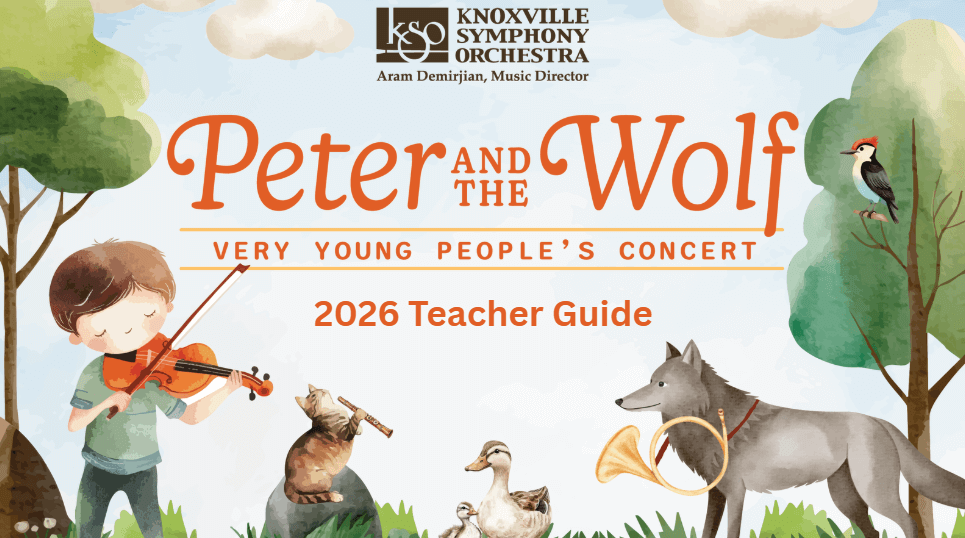
The VYPC Teacher Guide helps teachers connect classroom learning to the concert experience.
Sergei Prokofiev’s classic work remains one of the most effective introductions to orchestral instruments. Each character (bird, duck, cat, wolf) is represented by a distinct instrument, giving students a way to hear personality and narrative in sound. But its value, Gonzalez notes, goes even deeper.
“Peter and the Wolf is one of those pieces students remember long after the concert,” she says. “Once a child has heard the duck played by an oboe or the wolf played by horns, they start recognizing those sounds in other music. It gives them a way into the orchestra that feels personal and fun.”
To complement Peter and the Wolf, the KSO includes short selections that portray animals students might encounter in their own backyards like chipmunks, cats, dogs or butterflies. These works offer opportunities for teachers to explore early science concepts such as animal traits, senses, and habitats, all of which appear in Tennessee’s K–2 standards. “Peter and the Wolf gives us a foundation,” says Music Director Aram Demirjian. “But part of the fun is finding companion pieces that reinforce those ideas, how instruments create character, how rhythm shapes mood, or how a short musical moment can tell its own story.”
This blend of music, movement, and scientific observation also reinforces Tennessee’s Fine Arts standards, which emphasize expressive qualities, audience behavior, and understanding connections between music and other disciplines. To help ensure the Teacher’s Guide is developmentally appropriate and genuinely useful, the KSO maintains a Education Advisory Council comprised of classroom educators, choral directors, and instrumental teachers. The result is a program that feels playful and imaginative, yet is deeply aligned with what students are learning in school.
One of the most valued components of the Teacher Guide is the Concert Playlist, which introduces the music and themes before students ever take their seats. “We know teachers are balancing a lot,” Gonzalez says. “We try to give them tools that make their work a little easier and help their students feel more confident and prepared.”
Teacher preparation doesn’t stop with the guide. The KSO also sends pairs of musicians directly into classrooms for Meet the Musician visits, giving students a personal introduction to the instruments they will hear onstage. When a student recognizes the musician they met earlier during the concert, the connection is instant and suddenly the orchestra feels personal, someone they know is onstage.
Making those moments possible, along with the concerts themselves, requires year-round coordination across dozens of schools throughout East Tennessee, each with its own schedule, needs, and field-trip guidelines. That careful planning ensures the Very Young People’s Concerts are more than a single performance. They serve as an entry point: a welcoming, well-supported introduction to live orchestral music designed to inspire young learners.
Very Young People’s Concert
February 25, 2026 at 9:30 am – Tennessee Theatre, Knoxville
February 26, 2026 at 9:30 and 11:00 am – Clayton Center for the Performing Arts, Maryville
Sponsored by Jarrod Blue and John Law, the Boyd Foundation, Pinnacle Bank, Vulcan Materials Company, and Rotary Club of Knoxville.