








Inside Brahms’ Violin Concerto
Reflections on Performance and Collaboration
When violinist Vadim Gluzman steps onto the Tennessee Theatre stage for the KSO’s January Masterworks concerts, he brings with him one of the most revered works in the violin repertoire and a lifetime of lived experience inside its music.
Johannes Brahms’ Violin Concerto in D Major is often described as a summit piece: technically demanding, emotionally complex, and uncompromising in its depth. For Gluzman, it is a work that continues to reveal new meaning each time he returns to it. “What keeps you coming back to a masterpiece?” he says “You see something else in it every time. It’s inevitable.”
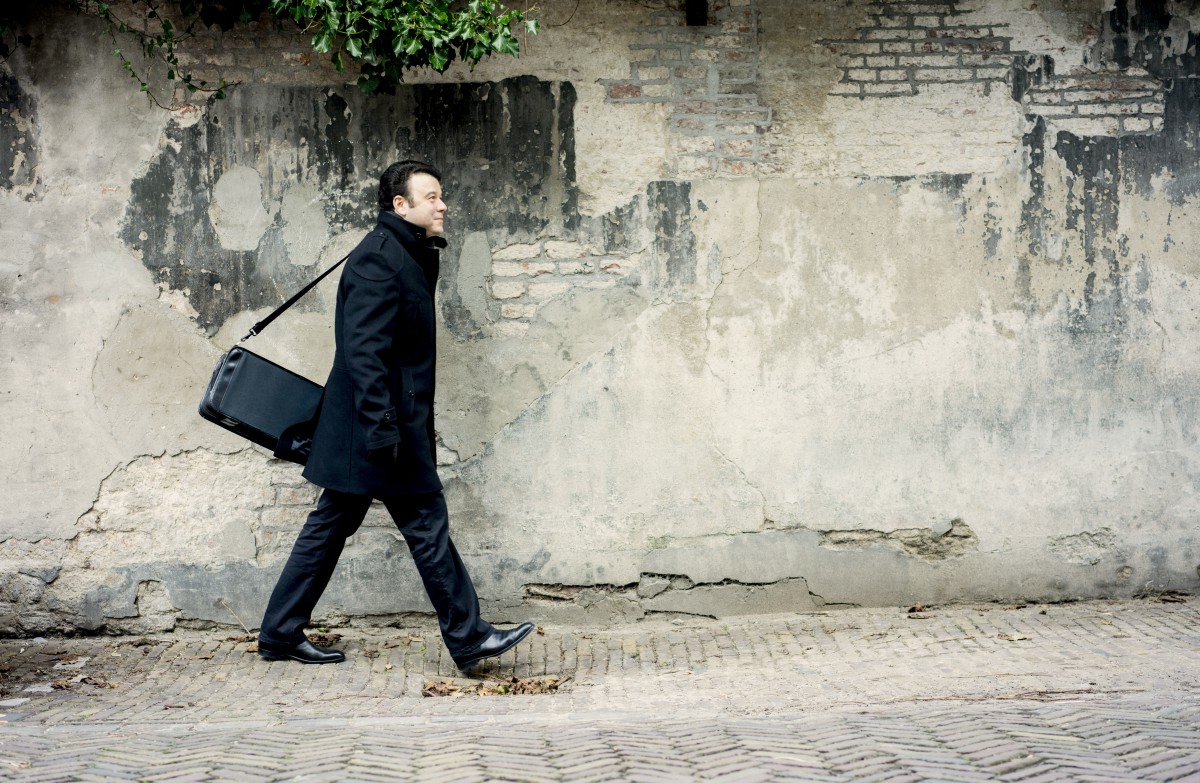
For violinist Vadim Gluzman, Brahms’ Violin Concerto remains a work of ongoing discovery.
That sense of discovery is central to Brahms’ concerto. Written for the composer’s close friend Joseph Joachim, the work is as much a symphony as it is a concerto, demanding not only virtuosity from the soloist, but collaboration with the orchestra. Gluzman resists the notion of the “soloist” as a lone figure. “Every music is a dialogue,” he says. “Every orchestra has a sound, and every conductor brings a different energy. Music is a living being.”
For KSO Music Director Aram Demirjian, that dialogue is exactly what makes Brahms’ concerto so powerful and challenging. “It almost demands everything the performer has,” Demirjian explains. “Authority and delicacy, introversion and exuberance, vulnerability and confidence. All living at once.” Demirjian often returns to a phrase from one of his own teachers: Brahms’ music is always living on two sides of the same emotion. It’s a quality that gives the concerto its unmistakable emotional tension, never simplistic, never showy for its own sake.
Gluzman knows that tension well. His interpretation of the concerto reflects more than three decades of performing the work with orchestras around the world, absorbing each experience into his evolving understanding of the piece. “My idea of this concerto today is a collection of all those experiences,” he says. “It changes because I change.” That evolution is closely tied to the instrument Gluzman plays: a legendary 1690 Stradivari once owned by Leopold Auer, teacher to an entire golden generation of violinists. Gluzman has performed on it for nearly three decades, and its sound has become central to his musical voice. “If I think violin,” he says, “I imagine the sound of this instrument.”
In Knoxville, that sound will meet an orchestra eager for collaboration and discovery. Demirjian notes that guest artists like Gluzman don’t simply perform with the orchestra, they change it.“His sound will feed into our sound,” Demirjian says. “It becomes a shared experience, and a learning experience, for everyone onstage.”
Gluzman Plays Brahms, part of the MoxCar Marketing + Communications Masterworks Series, will be performed Thursday and Friday, January 15–16 at 7:30 pm at the Tennessee Theatre. This concert is sponsored by Bill and Atie Rotmeyer.
Background on Brahms’ Violin Concerto is adapted from the KSO program notes by Ken Meltzer.